



 10 / 17

Page 10
Updates from the Research Networks
Animal Selection, Genetics and Genomics Network
Animal breeding that exploits natural animal variation in methane emissions is a mitigation strategy that is cost-
effective, permanent, and cumulative. The disadvantage, however, is that it takes time to see progress.
A choice to mate a dam with a certain sire
does only shows its effect when the progeny
is born and themselves producing. Therefore,
animal breeding should go hand in hand
with other mitigation strategies. In this way
synergies are created with a combination
of immediate responses (e.g. because of
changes in the diet), and long-term effects
(because of improved genetic ability of the
animals). In the upcoming months two
international, interdisciplinary meetings will
be organised by the ASGGN.
2015 has been busy for the ASGGN. The
invited review on “Genetic possibilities to
reduce enteric methane emissions from
ruminants” is now available online as
open access:
http://dx.doi.org/10.1017/S1751731115000968
. The review shows
that methane emissions (g/day) are a
heritable and repeatable trait. This opens up
the opportunity to start breeding for
lower emitting animals.
A Working Group on ‘Resource Efficiency’
was established at a joint meeting
with the International Committee on
Animal Recording (ICAR) in June 2015. Roel
Veerkamp and Yvette de Haas (Wageningen
UR) will chair the group. Its main aims
are to:
• Provide a forum for collaboration,
information exchange and experience
sharing on recording and using dry
matter intake data, and recording and
using methane outputs data, including
facilitating research collaboration.
• Maintain, update, promote and extend
universal guidelines for recording dry
matter intake and methane output in
cattle, sheep and goats worldwide.
• Carry out periodic international surveys
on recording dry matter intake and
methane output in cattle, sheep and goats
worldwide.
• Develop a system and standards for data
storage and genetic evaluation services
that will form the basis of services that
ICAR will provide to members of ICAR
and their research associates on a
user-pays basis.
Work continues on the ASGGN’s Adaptation
Working Group white paper on livestock
systems in developing countries (addressing
low quality diets, heat stress, disease
resistance, parasitism, resilience etc). The
results will be presented at the next ASGGN
meeting at the GGAA conference in Australia
in February 2016. The ASGGN was one
of the organising partners of the recent
joint meeting of the LRG’s six Research
Networks. The main outcome is that an
interdisciplinary approach is of additional
value to reduce the environmental impact of
ruminants. For ASGGN, collaborations with
either the Feed and Nutrition and Animal
Health Networks, or with Feed and Nutrition
and the Rumen Microbial Genomics
Networks are most logical. Opportunities to
submit joint proposals will be evaluated.
Another full-day symposium will take place
at the European Association of Animal
Production conference in Warsaw, Poland
on 31 August with presentations relating
to aspects of “climate smart cattle farming
and breeding” (e.g. economics, system
approaches) and also animal nutrition and
animal genetics.
If you want to learn more about the network,
participate in the debates or contribute
with data, please contact Yvette de Haas
( Yvette.deHaas@wur.nl)
.
More information
can also be found at
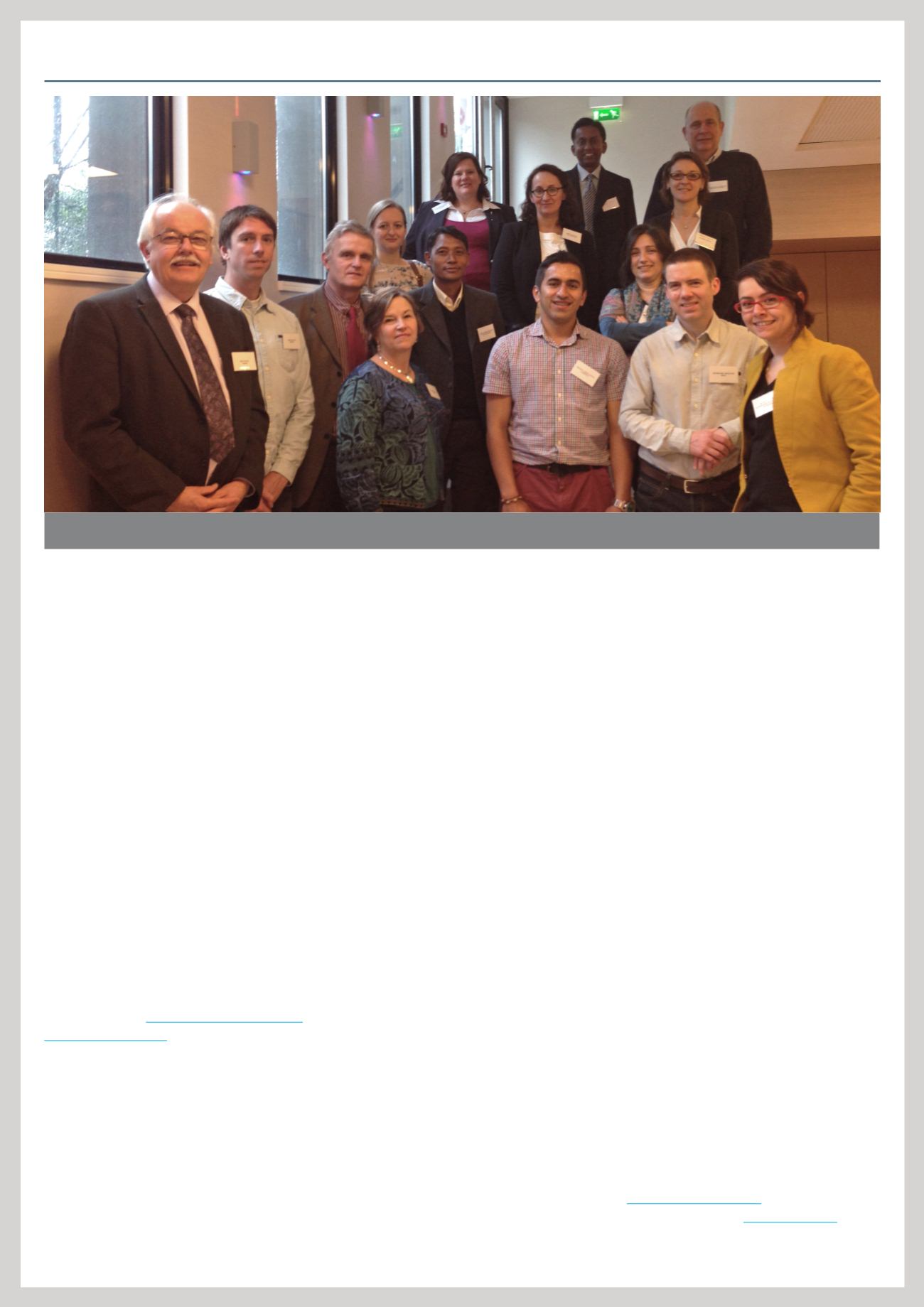
www.asggn.orgAnimal Health Network participants attending the workshop in Montpelier, France