



 3 / 17

Page 3
tasks and shared costs are agreed between
participating countries and then research
is funded towards those goals according to
countries’ domestic funding rules. The co-
chairs will develop those opportunities and
share additional information as it comes
to hand.
The LRG’s meeting location in Italy enabled
several
Mediterranean
countries
to
participate as observers including Greece,
Lebanon, Malta, Portugal and Turkey.
Discussions focused on the possibility of
building a regional momentum similar to
that in Latin America and South East Asia.
Italy has agreed to champion this issue and
reach out to other Mediterranean countries
to identify initial areas of mutual interest.
Carbon sequestration was confirmed as an
emerging topic of interest to LRG members,
as it offers particular opportunities to link the
Grasslands Research Network with CCAFS,
the Global Agenda for Sustainable Livestock,
and the Alliance’s own Soil Carbon and
Nitrogen Cycling Group. These options were
discussed in detail at a soil carbon workshop
held immediately following the LRG meeting
(for details, see page 4).
Outreach
The LRG’s outreach efforts are becoming
more important than ever in an increasingly
busy marketplace of climate change and
agriculture initiatives. The joint LRG and
SAI publication on mitigation best practice
and emerging options has proved a highly
successful venture and LRG members were
encouraged to promote the document in
their own countries. Translation into Spanish
is being explored. A high-level promotional
brochure is being developed by the Co-
chairs to help the LRG raise awareness of its
contribution to livestock emissions research
and the different ways that governments and
other relevant organisations can engage.
The LRG is also collecting case studies from
countries on different ways that countries
have successfully reduced the emissions
intensity of livestock production at local
and national scales. The idea is to create
a database to help countries learn from
each other’s experiences and demonstrate
opportunities for replicating and up-scaling
such measures.
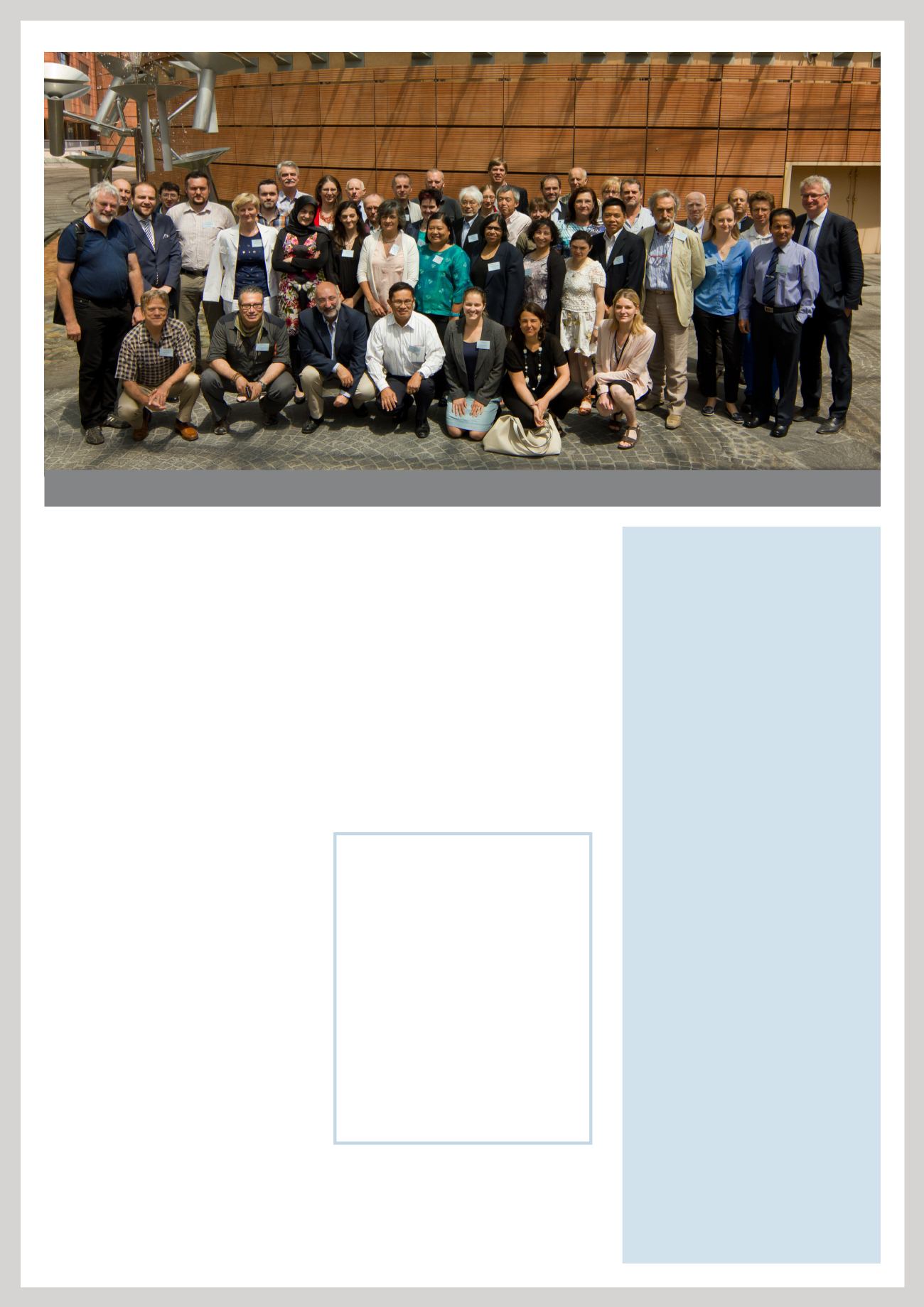
The LRG meeting 2015 at Centro Congressi, Lodi, Italy, 23-24 June 2015
The next meeting of the LRG will
be held in Melbourne, Australia,
19-20 February 2016, immediately
following the sixth international
Greenhouse Gas & Animal
Agriculture (GGAA) conference
(14-18 February).
Several LRG research networks are
planning their internal meetings in
the days before the conference.
Please book this into your diary now.
More details will be sent towards the
end of this year.
Working with the
Global Alliance
on Climate Smart
Agriculture
The LRG meeting in Lodi presented an
excellent opportunity to increase mutual
understanding between the GRA and
the Global Alliance on Climate Smart
Agriculture (GACSA). GRA and GACSA
havehighly complementarybut potentially
also overlapping objectives and modes of
engaging countries, industry, NGOs and
farmers to achieve more sustainable and
resilient agriculture production to feed a
growing global population.
The meeting heard presentations
from the two organisations leading
the GACSA’s Knowledge Action Group
(KAG), CCAFS and FAO, about the KAG’s
longer term objectives and immediate
priorities. The discussion focused on
areas where expertise and activities from
the LRG research networks could inform
KAG activities, but also more strategic
synergies between the LRG and KAG in
the areas of training, capacity building
and resourcing for activities.
The meeting also noted that the
multi-stakeholder nature of GACSA,
including its two additional platforms on
investment and enabling environments,
could usefully complement the strong
and direct links that the GRA provides to
governments.