



 8 / 17

Page 8
people directly and indirectly dependent
on livestock. There are many resource
constraints, amongst them the competition
for limited land with high value crops such
as soya bean and grain. In addition to these
there are climate change impacts on water
availability and pasture quality, which in
turn lead to low productivity of the cattle.
However, this also means there are many
opportunities for the livestock sector in
these countries to develop production
systems that increase efficiency and a
greater contribution to food security.
The workshop was opened by the INTA
president Francisco Angeliso and Jorge
Dillon the Under-Secretary for the Ministry
for Livestock in Argentina. It brought
together scientists, policy makers and
extension groups to discuss and identify
options for improving cattle production
system efficiencies; understanding how
the sector can contribute toward incomes,
food security goals, and wider economic
development. The participants in the
workshop also considered the barriers to
uptake of existing interventions and started
to reflect on how dialogue can be encouraged
with a broader set of stakeholders from the
sector to develop intervention strategies
that would work.
Next steps
Participants will work collectively within each
country to classify the beef production systems
in the region and identify the key interventions
and currently available or near future best
practice for the sector. This information
will be modelled by FAO to determine the
interventions that can have the biggest impact
on the production system efficiencies.
For further information about the
project contact Dr Victoria Hatton
the
project
activity
coordinator
( victoria.hatton@fao.org ).
Participants represented the following
organisations:
Uruguay:
The National Institute of
Agricultural Research (INIA), Instituto Plan
Agropecuario, the Ministry of Agriculture
and Fisheries (MGAP) and the University
of Uruguay.
Argentina:
INTA, AACREA (Asociación
Argentina de Consorcios Regionales de
Experimentación Agrícola), AAPA (Argentine
Animal Production Association), National
University of the Province of Buenos Aires,
the Instituto de Promocion de la Carne
Vacuna Argentina and the Ministry for
Livestock and Fisheries.
Brazil:
University Federal of Rio Grande Sul
and IMAFLORA.
Project Outline:
The project will develop and disseminate innovative, evidence based intervention options
by supporting the identification of opportunities and interventions that result in multiple
benefits for ruminant livestock producers including gains in productivity, improved food
security and a reduction in enteric fermentation.
The FAO Global Livestock Environmental Accounting Model (GLEAM), will be used
to simulate the interaction of opportunities and interventions involved in ruminant
livestock production and the environment. Through an iterative process with key regional
stakeholders, the data and production systems used in GLEAM will be, if necessary,
updated to reflect actual measured conditions/parameters.
The CCAC project is in two phases; phase two funding is contingent on the results
of phase one. In phase one we will work with local researchers, policy and farmer
extension groups to design the cost-effective suites of practices (technical packages)
that can have the biggest impact on production system efficiencies and enteric methane
abatement, prior to establishing demonstration sites and replication strategies in phase
two.
During phase one, we will work with regional partners to develop the best ways to
illustrate the technologies and interventions that are available and being implemented.
Certainly we understand already that there are gains being made by implementing
small, simple practice changes like fencing, improved water supply for the cattle, and
improvements to pasture that enable farmers to intensify their production.
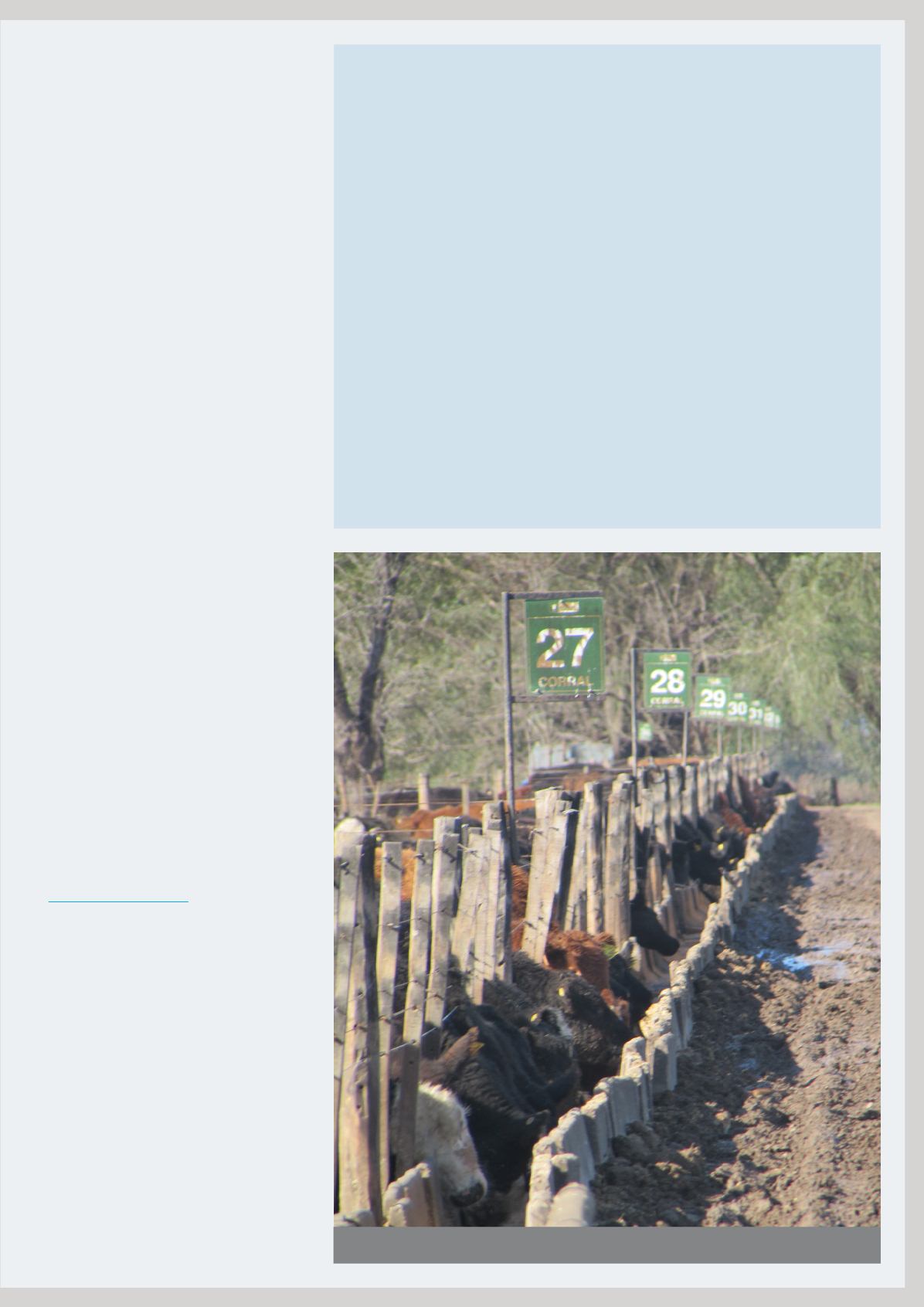
El Trebol feedlot, Argentina