



 3 / 12

Page 3
The rumen is the modified foregut of these
animals. Microbes ferment food in the
rumen, allowing the animal to extract energy
from feed such as grasses that otherwise
could not be digested. These microbes are
therefore essential for ruminant productivity.
Unfortunately, one of the by-products of
this fermentation is the greenhouse gas,
methane. This is produced by microbes
called methanogens. The microbial survey
extracted DNA from all samples and
sequenced diagnostic marker genes that
allowed the identification of different bacteria
and methanogens. Once the data had been
explored, the findings were checked back
with census collaborators around the world.
The initial hypothesis was that rumen
microbes would be similar to some extent
across the world, but that diets or other
factors would make a difference. Peter
Janssen, who leads part of New Zealand’s
methane mitigation research, says the
rumen microbes ended up being more
similar than they had expected. Mostly they
were the same in all samples, but some
microbes were more strongly associated
with certain hosts and some with certain
diets.
“The rumen methanogens turned out to be
highly similar species in all rumens across
the world. Only a few species appear to be
responsible for the methane produced by
ruminants everywhere. Thismeansmitigation
strategies can be developed to target the few
dominant methanogens, and a technology
that’s developed in one place should be
applicable everywhere,” says Janssen.
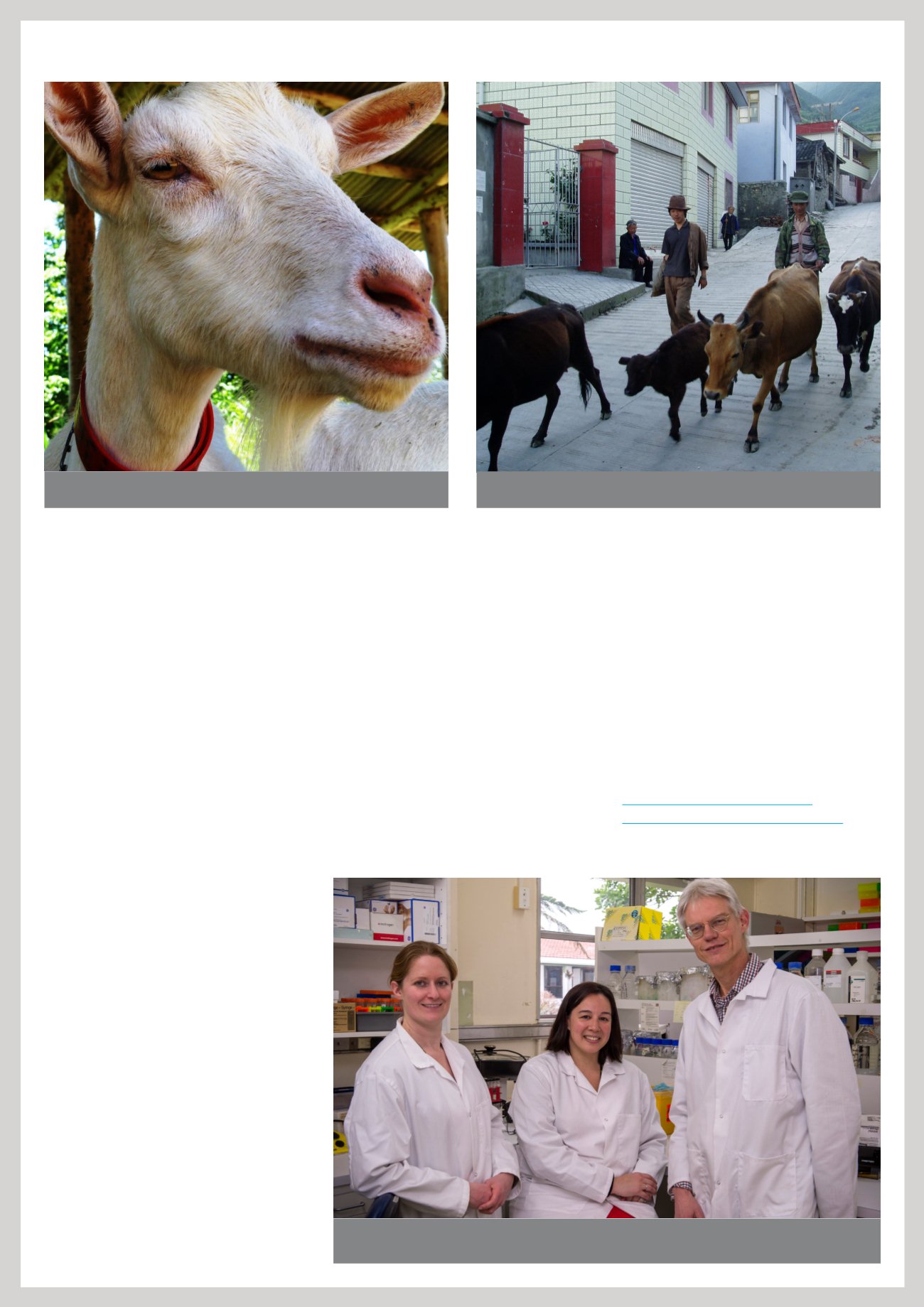
Cattle in the Sichuan province of China
New Zealand researchers leading the project: from left to right Gemma Henderson, lead
researcher; Faith Cox, research associate; and Peter Janssen, lead researcher.
Brazilian goat
Harry Clark, Director of the New Zealand
Agricultural Greenhouse Gas Research
Centre and co-chair of the LRG, says this
study shows the real power of international
research collaboration possible through the
GRA, with the study identified by the LRG’s
Rumen Microbial Genomics Network as a
flagship initiative when the network first
came together in 2011.
“This study has provided knowledge that
no country could have delivered on its own,
and the benefits are also international.
The Global Rumen Census shows that
new mitigation technologies that tackle
the microbes responsible for methane
production in ruminants can make a real
difference at the global scale. Modifying
the rumen is an enormous challenge, but
collectively we have a chance to get there.”
The Global Rumen Census complements
New Zealand’s large domestic research
programme focused on methane-mitigation
technology,
particularly
vaccines
or
inhibitors to suppress methanogens. The
New Zealand Government’s Ministry for
Primary Industries funded the main part of
the study as part of its support for the GRA.
For more information, please contact
peter.janssen@agresearch.co.nzor
gemma.henderson@agresearch.co.nz .