



 8 / 12

Page 8
Collaborating on global
agricultural mitigation potential:
an update on progress
In an ongoing series for the LRG newsletter,
we bring you another update on progress
with the LRG’s flagship collaborative
capability building project with the FAO
and CCAC, ‘Reducing enteric methane for
improving food security and livelihoods’.
The project team recently held regional
workshops in South Asia and Sub-Saharan
Africa. These were an opportunity to
bring together policy, science, industry
and livestock extension organisations to
discuss key regional production systems,
interventions which are available or near to
market, constraints affecting the uptake of
such interventions and the economic cost to
farmers.
Twenty-five participants from Sri Lanka
and Bangladesh attended the South Asia
regional workshop, hosted by the National
Science Foundation in Colombo, Sri Lanka,
27-28 August 2015. (It was not possible
for participants from India to attend but
they will be contributing data). Significant
numbers of the world’s cattle, buffalo and
small ruminant populations are found in
South Asia – 20%, 78% and 23% respectively.
Twelve percent of global milk production
comes from the region and 92% of buffalo
milk, along with 23% of global edible protein
from small ruminants.
Thirty-two participants from Ethiopia, Kenya,
Tanzania, Uganda, Benin, Senegal, Mali,
Niger and Burkino Faso travelled to Addis
Ababa for the Sub-Saharan Africa workshop
from 31 August – 2 September. Over 200
million people rely on livestock for income
in the region, which is home to 17% of the
global cattle population and 23% of small
ruminants. Ruminants in the region are fed
diets mainly based on highly fibrous material
and usually show only a marginal level of
productivity; the region producing only 4% of
the global protein from cattle and 12% from
small ruminants.
The sharing of such information even at this
early stage has provided a rich picture of dairy
production in South Asia and Sub Saharan
Africa. As with the regional workshop held
in Argentina in June (reported in the July
2015 newsletter), the next steps are to work
with country-nominated focal points to
collect baseline data for their key production
systems, interventions and constraints
to input in to the FAO’s Global Livestock
Environmental Assessment Model (GLEAM).
This will identify regionally appropriate
intervention packages for testing and
upscaling in the second phase of the project.
For further details of the project please
contact the project coordinator, Victoria
Hatton
( victoria.hatton@fao.org ).
Participants at the South Asia workshop in Colombo
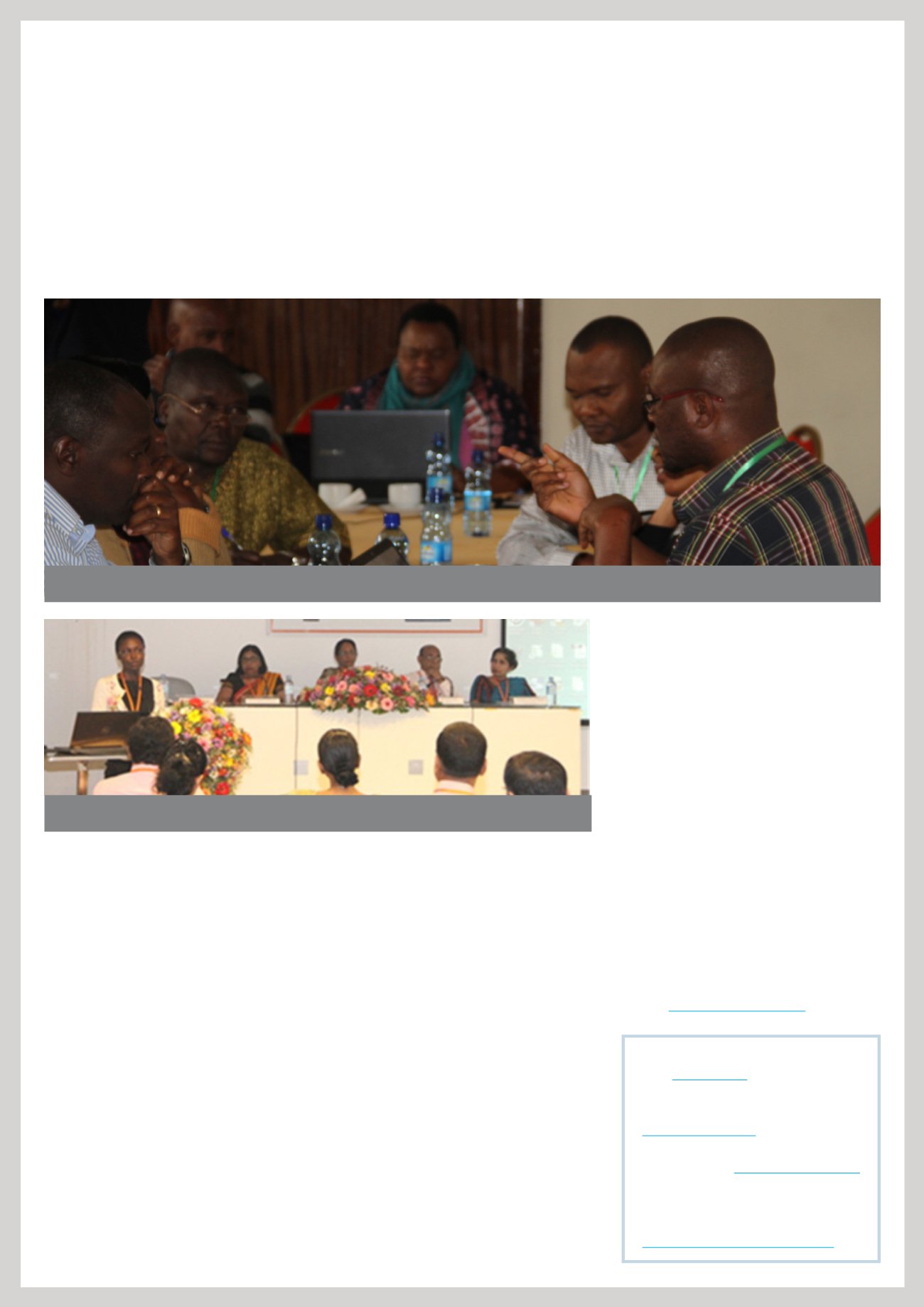
Participants at the Sub-Saharan Africa workshop in Addis Ababa
This project is a collaboration between
FAO (
www.fao.org )and the LRG, led
by the New Zealand Agricultural
Greenhouse Gas Research Centre
(
www.nzagrc.org.nz ). Funding is jointly
provided by the Climate and Clean
Air Coalition (
www.ccacoalition.org )and the New Zealand Government, in
support of the Global Research Alliance
on Agricultural Greenhouse Gases
(
www.globalresearchalliance.org ).