




 2 / 12

Page 2
Countries
are
increasingly
interested
in
understanding
how their national greenhouse
gas (GHG) inventories can more
accurately capture the impact of
improved agricultural productivity
in terms of reducingGHGemissions
intensity.
The GRA has the dual purpose of reducing
emissions intensity of food production while
also supporting and enhancing food security.
In livestock systems, it is commonly accepted
that this is most effectively achieved by
Advancing greenhouse
gas inventories in
South-East Asia
increasing the productivity of animals and
the efficiency of farm systems. Many of the
practical steps to achieve this have been
summarised by the LRG in conjunction with
the Sustainable Agriculture Initiative (SAI)
Platform in a
recent documenton current
best practices and emerging options to
reduce greenhouse gas emissions from
livestock.
As animals increase their productivity, their
emissions intensity decreases because less
of the energy they consume is used for body
maintenance and more is used to produce
milk and meat. But such reductions in
emissions intensity remain invisible in many
countries, because they use so-called ‘Tier
1’ inventories to report their greenhouse gas
emissions from livestock. Tier 1 inventories
calculate emissions based on the number
of animals and an emission factor (e.g. kg
methane per animal per year). Since these
emission factors are not assumed to change
over time, such inventories are not suitable
for reporting changes in emissions intensity.
By contrast, Tier 2 inventories calculate
emission factors based on the amount
of energy or dry matter consumed by
animals, and a methane yield that gives the
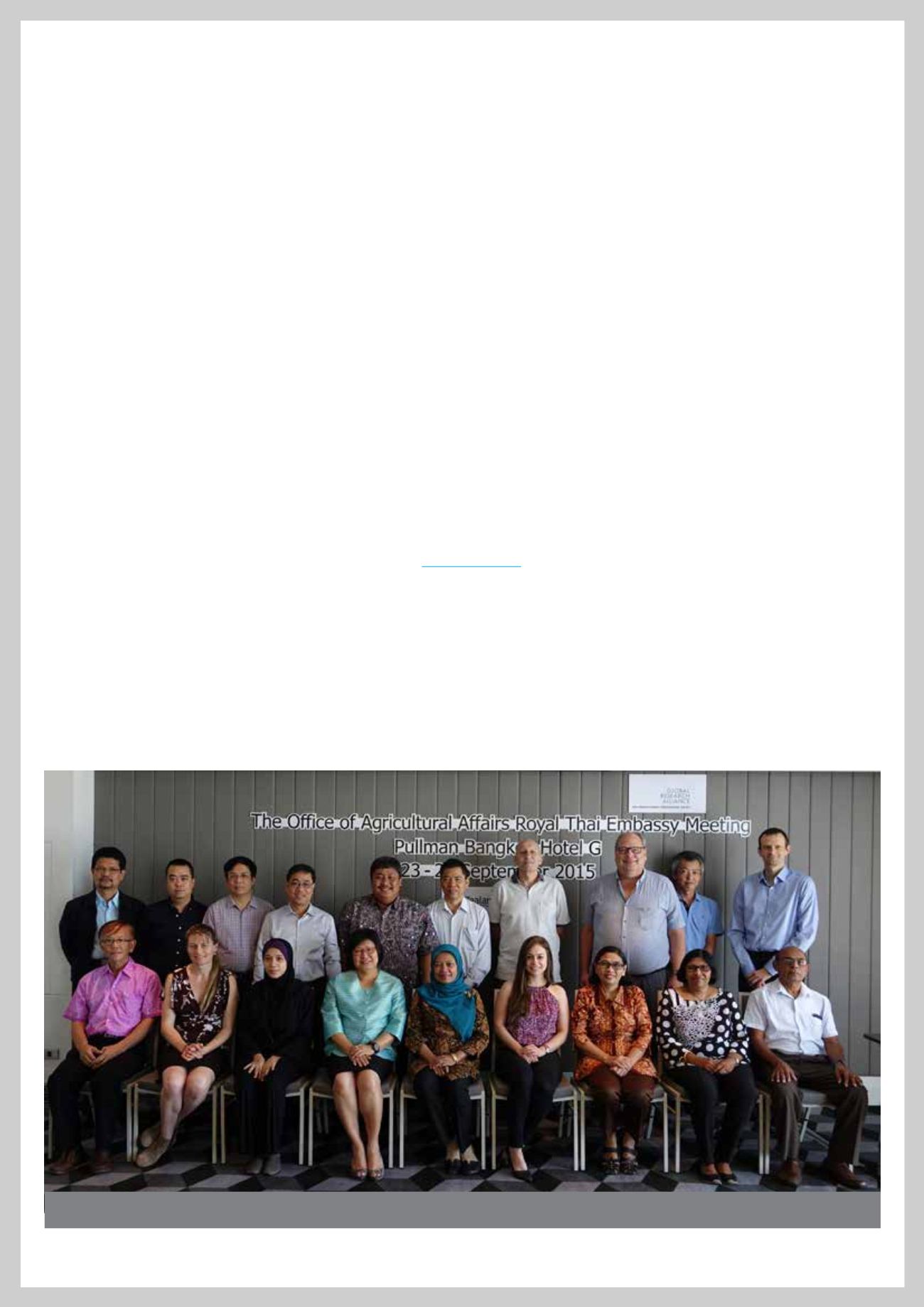
Participants at the LRG inventory workshop in Thailand, September 2015.