



 8 / 12

Page 8
Work is underway in Uganda to establish a framework for a national greenhouse gas (GHG) inventory system.
However, with very little data on methane emissions from the different livestock production systems across the
country and very fewpeople trained inmeasuring these emissions, it is a challenge to accurately include information
on livestock in the national inventory.
Last year, the New Zealand Government
sponsored a LEARN fellow from Uganda,
Stephen Olinga, to receive technical training
in New Zealand on livestock emissions
measurement (see the
October 2014 LRG Newsletter ). To continue building Uganda’s
scientific capability in livestock emissions
measurement, a second LEARN technical
training fellowship has been awarded to a
Ugandan scientist – Paul Boma, who works
with Stephen at the Ugandan National
Agricultural Research Organisation (NARO).
Paul is a qualified veterinarian, currently
acting Program Leader Livestock and
Fisheries Research and Development based
at the Nabuin Zonal Agricultural Research
and Development Institute in the Karamoja
region. He works on dry season feeding
projects, including evaluating different
grasses and legumes for adaptability in
the dry lands, their nutritive value and
identifying grass-legume combinations for
ruminant feeding to improve productivity
and reduce the time to market from the
current 4-5 years to 1.5-2 years. He is also
working to encourage Ugandan pastoralists
to adopt pasture preservation techniques
(especially hay and silage making) during
times of growth for feeding livestock during
the long dry spells, and is spearheading
a cattle cross-breeding program between
the small east African zebu and the Jersey
and sahiwaal breeds for increased milk
production.
Paul is visitingAgResearch inNewZealandon
a six month LEARN technical training award
to gain knowledge and skills in methane
measurement techniques in ruminant
livestock, in particular around the SF
6
tracer
technique. He will be involved in a dairy
cattle trial using SF
6
including subsampling
and preparation and maintenance of SF
6
gear, and will participate in other studies
using different measurement techniques
including respiration chambers and in vitro
gas production. For the in vitro technique,
he will learn to use the automated system
developed in New Zealand, but will also
work with a manual system, which is more
readily applicable to research programmes
in Uganda.
Paul hopes to use this knowledge to
contribute to a Ugandan working group
that was set up in July 2014 to generate
data for the livestock sub-sector in order to
understand its contribution to the national
GHG inventory. He also wants to work with
farmers and local government to improve
their understanding on why it is relevant to
mitigate greenhouse gases from livestock.
Thanks to this LEARN award, Paul will boost
the technical capacity available in Uganda to
inform policy development on the research
agenda of livestock GHG emissions and their
mitigation.
Supporting livestock emissions
measurement in Uganda
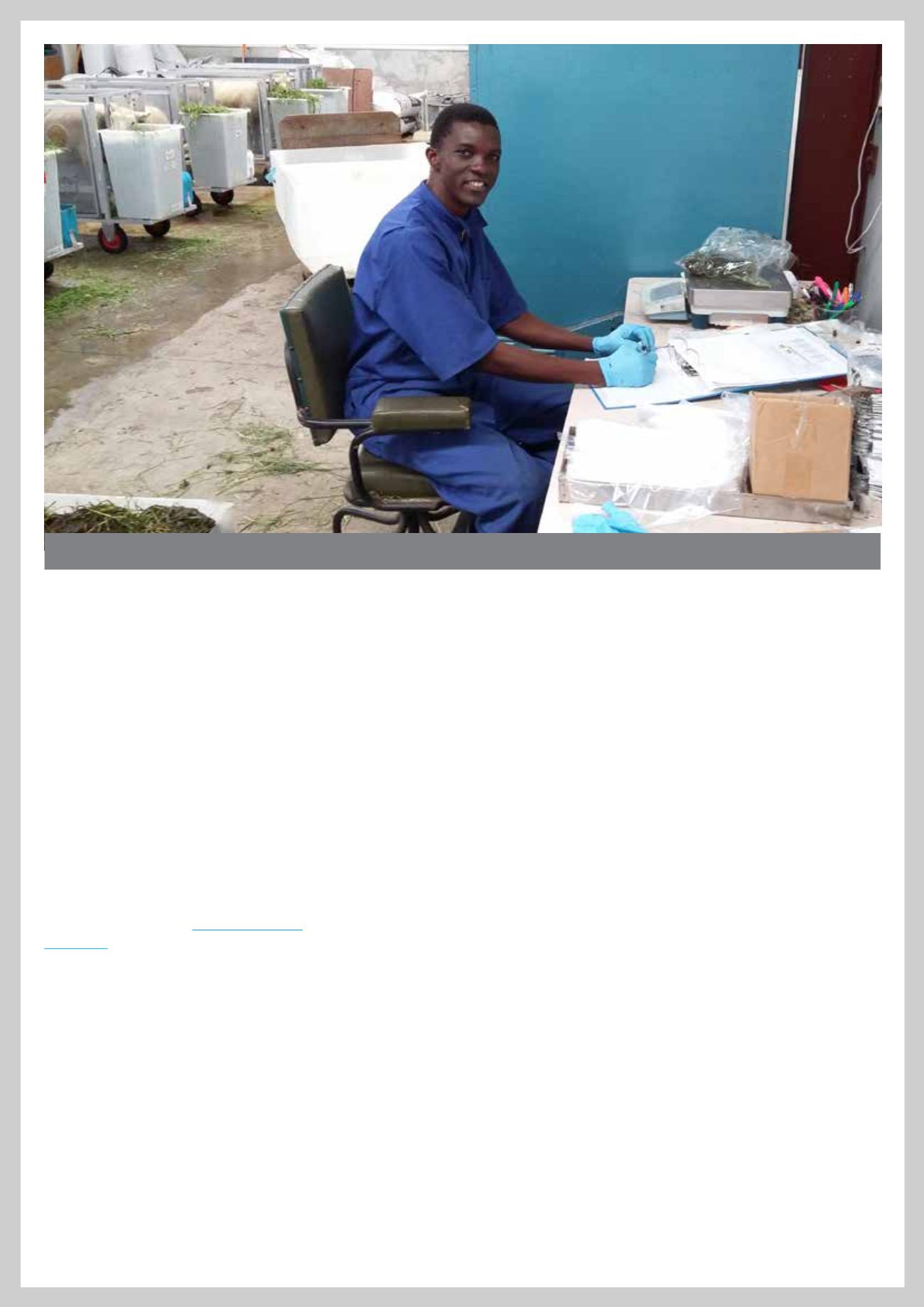
Paul Boma, recipient of a New Zealand LEARN technical training award.