




 9 / 12

Page 9
New Zealand dairy farmers collect around 70 million m
3
liquid manure annually from milking parlours and feed
pads – a large source of both methane (CH
4
) and nitrous oxide (N
2
O) emissions.
Scientific understanding of emissions from
dairy farm effluent management in New
Zealand’s predominantly pastoral dairy
systems is limited and it is not clear to what
extent mitigation options developed overseas
can be applied to those systems. A Global
Research Alliance Senior Scientist (GRASS)
Award recently enabled New Zealand and
Danish scientists to collaborate on a joint
project to expand knowledge in this area.
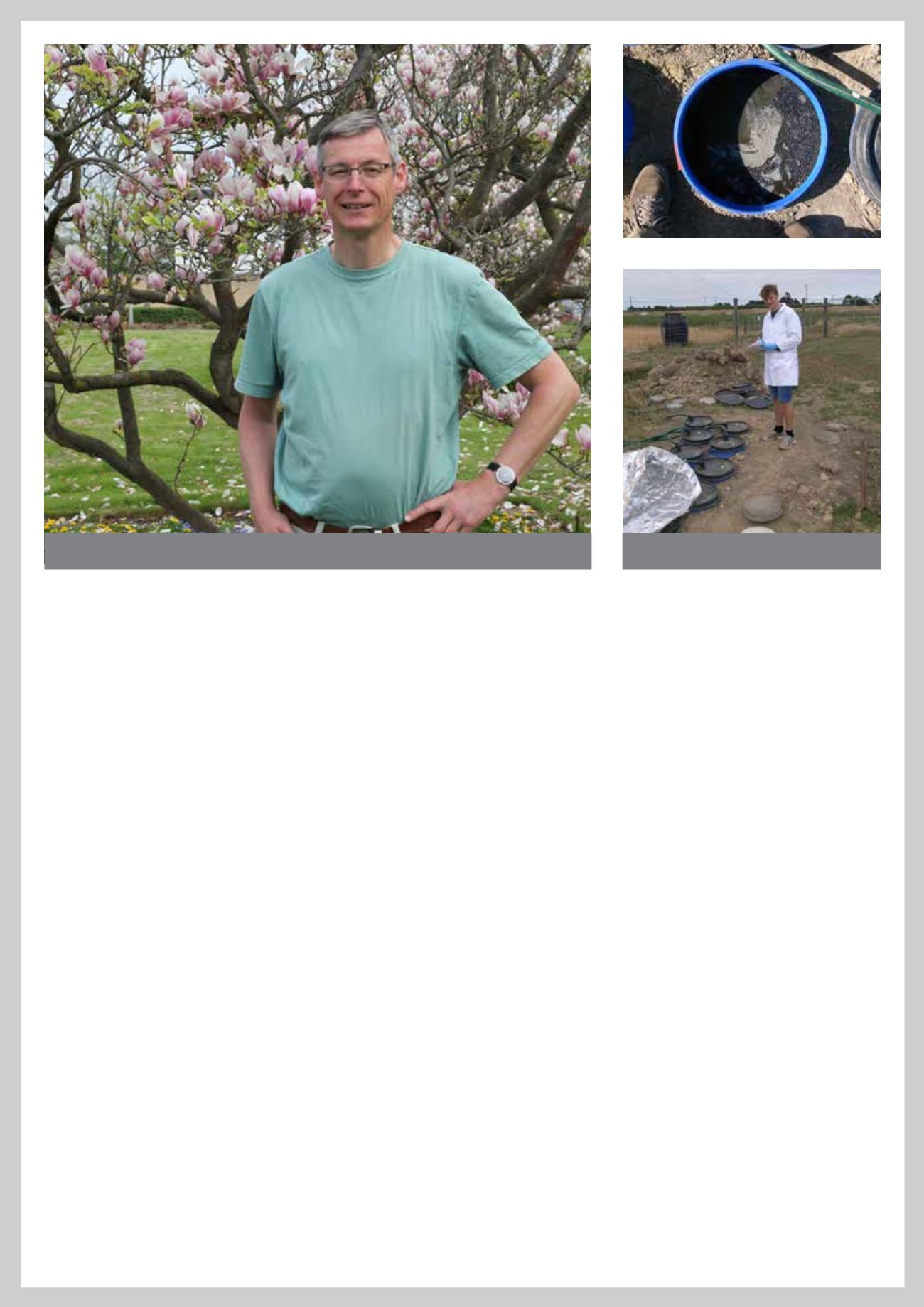
Dr SvenSommer, aProfessor at theUniversity
of Southern Denmark and a European
expert in livestock manure management to
reduce greenhouse gas emissions, spent
five months at Lincoln University this year
working with Dr Tim Clough, Professor of
Environmental Biogeochemistry. Together
they explored the hypothesis that CH
4
and
N
2
O from liquid manure could be reduced
by either acidification of the manure or by
liquid manure separation immediately after
transfer from feed pads andmilking parlours.
Acidification of livestock slurry is already
considered an efficient technology to
reduce ammonia (NH
3
) emissions from
stored livestock manure because release
of NH
3
stops at a low pH. The joint research
investigated whether acidification of stored
slurry could also inhibit the microbial
transformation of organic matter in
anaerobic ponds and therefore reduce
methane production. The team found that
reducing the pH to 5.5 significantly reduced
CH
4
emissions initially but with time the
microorganism adjusted, pH rose and
emissions increased again.
Separation of slurry reduces its organic
matter content, which can also reduce
N
2
O emissions from field-applied manure.
However, it was found that liquid manures in
New Zealand are already very low in organic
matter, compared to European systems, due
to separation as a result of manure storage
(weeping walls, screw press, filtering etc).
Consequently, emissions are also lower and
further reductions from additional manure
separation were found to be insignificant
when liquid manure, with either high or low
dry matter content, was applied to a well-
drained silt loam soil.
The findings underscore the need to test and
develop locally appropriate solutions, even
where mitigation options exist in principle
in other countries’ farm systems. While the
study did not result in immediately applicable
mitigation options, it created an important
link between researchers and their
institutions on which to build further efforts.
As dairy systems in New Zealand further
intensify and increase their productivity,
effective management of manure to
minimise greenhouse gas emissions as well
as odour and water quality implications will
become all the more important.
Reducing CH
4
and N
2
O emissions from
liquid manure:
outcomes of an exchange
between New Zealand and Denmark
Dr Sven Sommer, GRASS award recipient from the University of Southern Denmark.
Technician from Lincoln University taking
samples from stored liquid manure.